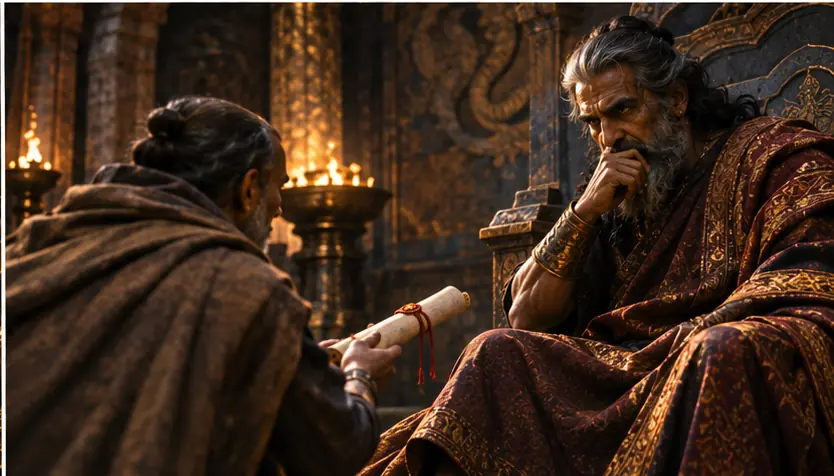
The messenger had no royal seal and asked for water before he would give his news. His cloak smelled of smoke from roadside fires. The soles of his sandals had worn thin enough for the stones to cut his feet. Sumali received him in the chamber beside the map room, where a servant had set out a stool and a cup of watered milk. The traveller carried a note copied from a shrine keeper's account: Kaikasi had crossed the second river, declined an escort and continued toward the forest paths beyond. Sumali read the lines twice. He asked whether she had been hurt. The man said no injury had been reported. He asked whether she had been afraid. The man could not know.
He had imagined a letter in his daughter's hand, perhaps a request for assistance or a report that Vishrava had agreed to receive her. The copied note offered neither. Its words were careful and impersonal, written by someone who knew only what the shrine keeper had seen.
The traveller waited for another question. Sumali wanted to ask whether she had spoken of him, but the man had already admitted that he had never met her. He gave him payment for the road and ordered the kitchens to feed him. Only after the door closed did he turn the note over, as though something might have been written on the back.
Malyavan found the message lying beside the map. “She is safe,” he said.
“She is alone.”
“She chose to be.”
Sumali folded the paper. “You think that makes it better.”
“I think it makes it hers.”
The brothers had grown old in different ways. Malyavan moved slowly because his wounds pained him. Sumali moved quickly because he could not bear to stand still. He remembered teaching Kaikasi the names of Lanka's gates, correcting her when she confused the western harbour with the old road. He could not remember whether he had ever asked what she wanted to learn.
Before going to the pool, Sumali visited the chamber where Kaikasi had learned to write. A servant had been instructed to keep it ready for her return, though no one knew when or whether she would come back. Her practice tablets lay stacked by the wall. One bore a list of questions she had once intended to ask the keeper of the upper gate: how far the road ran, who tended the shrines, whether travellers could buy food without showing a seal. He had dismissed the questions as childish when she first put them to him. Now he read them carefully. The questions were not about conquest. They were about living somewhere he could not supervise.
He called for Rujan, the captain who had escorted her to the second crossing. The man arrived expecting to be questioned about her safety. Sumali asked whether she had been treated with respect along the road. Rujan described the shrine, the ford and the argument over the toll. He hesitated before recounting Kaikasi's insistence that he return without following her. Sumali listened. He wanted to rebuke the captain for yielding, but the order had been clear and Kaikasi had negotiated it in front of witnesses. Rujan had obeyed both the letter and the spirit of the command. Sumali dismissed him with thanks. The captain looked surprised enough that Sumali almost withdrew the word.
At the lower pool, Tarini and Ila were preparing the household count for the council. The results had surprised everyone. Many families wished to return to Lanka if land and safety could be secured. Others would go only if their work could be continued there. Some refused to leave Rasatal at all. The names did not divide neatly by age or ancestry. Tarini had expected that. Sumali had not.
He asked Ila to read the figures aloud. She did so without commentary. When she reached the families who intended to remain, Sumali asked whether their reasons had been recorded. Ila said they had been invited to give them, but no one had been required to explain a refusal. Sumali looked at the blank spaces. For a moment he wanted to fill them with his own explanations: fear, forgetfulness, comfort. Then he remembered the schoolroom, the cistern and the child whose leg had been set because the gate remained open.
“Leave them blank,” he said.
Tarini raised her eyes. She had known Sumali long enough not to mistake a single decision for a changed nature. Still, she wrote the instruction in the margin and asked him to sign it. He signed. He disliked the careful way she dried the ink, as though she expected him to change his mind before it set.
Ila asked Tarini whether she thought the king had changed. They were sitting at the edge of the pool, where children were gathering reeds for their boats. Tarini said that people changed every day in small ways and remained themselves in larger ones. Ila wanted a clearer answer. She had watched Sumali permit families to decline the return, and she had watched him brood over the same map as though the names in her ledger were merely obstacles on a road. Tarini asked her to imagine the king faced with a chance to take Lanka without a hearing. Would he remember the schoolroom, the cistern and the families who had refused to go? Ila did not know. Neither did Tarini. The uncertainty was why she continued keeping records.
On an ordinary evening, long after the Festival of Lamps, Leela taught the youngest children to fold leaves without tearing them. One boy wrote the name of a grandfather he had never met. Another wrote the name of a woman who had lived and died in Rasatal without seeing Lanka. A priest questioned whether that name belonged among the exiles' dead. Leela said the child had lost her and wished to remember her. The priest examined the little boat, then helped the boy set it on the water.
Before the gathering ended, the channel was crowded with little lights. Some names had been written too large for the leaves; ink ran where a child had pressed too hard. Malyavan brought a basket of sweets and found that the children had eaten half before the priests arrived. Tarini sat beside the water with Ila, correcting a date in the ledger. Sumali watched from the steps above them.
A small boy asked why the lamps travelled away instead of returning. His grandmother said the water carried them where it wished. The boy was dissatisfied. He fetched a stick and tried to turn one boat against the current. It spun, caught on a stone and went out. The grandmother gave him another leaf and told him to make a better boat. Sumali watched the boy work with his tongue pressed against his lip, unwilling to surrender the task.
Later, in Kaikasi's chamber, Sumali found the plant she had left behind. Its roots had broken the old bowl. He had ordered a larger one months earlier and never chosen it. He carried the plant himself to the storeroom and selected a plain vessel of fired clay. The servant offered a gold pot from the old palace stores. Sumali refused. Gold would not give the roots more room.
The next morning a delegation of watch captains came to ask whether the families who declined the return should continue receiving the same grain allotment. Their spokesman had prepared the question carefully. He said a settlement could not feed men who would not defend its future. Sumali asked whether the allotment was a reward for promising to march or payment for work already done. The captain replied that the distinction would be difficult to explain to the soldiers. Tarini, summoned to provide the figures, placed a list of the families on the table. It included quarrymen, cooks, two armourers and the widow who tended the lamps at the lower gate. The captain had eaten their bread and walked under their lights for years.
“If I cut their grain,” Sumali said, “who repairs the watch's boots?” The captain said the loyal families could take over the work. Tarini asked how many had been trained. He could name one apprentice. Sumali told him to return with a plan that included the wages and training required. The captain understood that his proposal had been refused, but he left with enough courtesy to pretend the king had merely postponed judgment. Tarini stayed behind. She asked whether the order should be recorded. Sumali said it should, and that the allotments would remain unchanged unless the council voted otherwise.
Malyavan arrived after the captains had gone. He read the entry and asked why his brother had not simply dismissed the men. Sumali said a dismissed captain returned to the barracks with a grievance, while a captain sent to calculate wages might return with an understanding of them. Malyavan gave him a long look. “You sound like Tarini,” he said. Sumali replied that he had spent years being told he did not listen to her. “And now?” Malyavan asked. Sumali folded the paper. “Now I am discovering how often she was right about matters I thought beneath me.” He did not say it kindly, and Malyavan did not mistake it for surrender.
That afternoon the messenger from the shrine was brought back to the records office to confirm the route in his note. Ila compared his account with Rujan's report. The shrine keeper had seen Kaikasi after the escort turned back, not before; the messenger himself had not seen her at all. Ila corrected the entry so that no one could later claim a witness had followed her to Vishrava. Sumali asked whether this meant she might have taken another road. Ila said it meant only that they did not know. He looked at the blank line she had left for her next confirmed sighting. He had ordered maps drawn of every road he could imagine, yet he could not fill that space without inventing a fact.
He returned to the map room after midnight. The western gate of Lanka lay beneath his hand, its towers drawn as they had been before the battle. He had learned the distances between the quays and the palace, the depth of the channels and the positions of the old guardhouses. The map contained no schoolroom, no broken cistern and no house where a woman sold oil beneath a leaking roof. He searched the margins for the cisterns, the lower market, the workers' houses. The mapmaker had drawn the palace's drains in blue ink but left the crowded wards beyond the western gate almost blank. Sumali had never asked him to fill them.
He took a fresh sheet and began writing questions for the day his descendants might see Lanka. How many families lived in the lower wards? Who kept the water moving? What had happened to the houses left behind? Who would be asked to give up a home in the name of restoring another? He wrote until the lamp guttered. Then he set the sheet beside the old map. It was not a plan for conquest. It was not yet a plan for peace.
Beyond the upper passage, the roads climbed through wet trees toward Vishrava's hermitage. Sumali traced the route as far as the second crossing, where Rujan's report ended. He could send another escort, but Kaikasi had dismissed the first. Whatever she said when she reached the sage's fire would be hers to say. He folded the map and set it beside the questions he had written. A footstep sounded beyond the door; he looked up before he could stop himself. It was only the night watch passing along the corridor. He let the man go by without calling out.