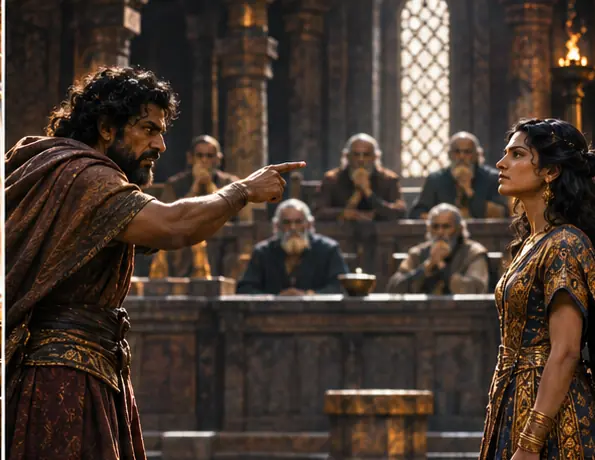
In the early years of Kuber's rule, long before Kaikasi left Rasatal, Sadhan knew an accusation had reached the palace before the guards came for him. The warehouse foreman stopped speaking when he entered the yard. Pera, his apprentice, had been ordered to take the morning tally without him. At sixty-three Sadhan could read a silence as easily as a cargo register. He had kept the western warehouse keys through Mali's last campaign, Sumali's retreat and Kuber's first years in Lanka. His wife told him to leave the keys behind when he went to court. He took them anyway. Whatever the charge, he wanted the new king to see what had been entrusted to him and how long he had carried it.
His left eye had clouded with age, but he could still tell a damp grain sack by its smell. The iron rings were wrapped in oiled cloth against the salt air. When the guards entered the yard, he gave Pera the slate and asked him to finish the count. Pera's hand shook so badly that the chalk snapped. Sadhan told him to fetch another piece. The guards waited while the boy did so.
At home, before the summons, his wife had argued that the keys should be surrendered to Pera. Their son worked on the eastern quays under a foreman who called the old officers parasites; a conviction would cost the boy his place as surely as it cost his father the warehouse. Sadhan promised to say nothing unnecessary. His wife asked him whether he knew the difference between unnecessary and proud. He did not answer, which she took for an answer.
On the way to the palace the guards led him past the western warehouse. A plank slipped from a labourer's shoulder and struck the stones. The foreman shouted at the boy, but Sadhan saw that the leather sling had cracked. He stopped to point it out. One guard tugged his sleeve; the other waited while the foreman inspected the strap. Sadhan was still carrying the keys. They struck against his hip all the way to court.
He had served Mali, though he had never seen the king closer than the width of the great hall. He had served Sumali more directly, signing the lists that sent provisions to the fleet. After the defeat, he had stayed because his wife was too ill to travel and because the ships were already crowded. For years he had wondered whether that decision made him a coward. The men who fled sometimes called those who remained collaborators; the men who stayed called the exiles deserters when they thought no one could hear. Sadhan had learned that a man could be condemned by both sides for surviving the same disaster.
The council chamber smelled of fresh lime. Kuber had ordered the plaster repaired after rain entered through the eastern wall, but the work was incomplete. A mason stood on a ladder while ministers argued beneath him. Sadhan waited near the door until Kuber dismissed the mason and asked him whether he had hidden grain for Sumali.
“I hid grain,” Sadhan said.
The ministers leaned forward. Kuber asked him to explain.
“When the evacuation began, soldiers were taking the stores for the ships. There were families still on the lower roads. I moved thirty sacks into the cellar beneath the old customs house. I meant to give them to the people who could not board.”
“Did you?”
“Some. Then the fighting reached the harbour. I could not get back to the cellar.”
“What happened to the grain?”
“It spoiled. The cellar flooded after the gates were broken. I went back when the city was quiet enough. There was nothing fit to eat.”
The merchant who had accused him called this a convenient story. Sadhan said there were three surviving witnesses, including Jaya, whose father had helped carry the sacks. Jaya was summoned from the oil market. She arrived with a stain on her sleeve and a temper sharpened by being made to abandon her stall. She remembered the cellar, the sacks and the smell when they were opened months later. She also remembered that Sadhan had charged her father for two sacks of grain before the evacuation. He had not been a generous man.
“Then he profited from the emergency,” the merchant said.
“He profited from many things,” Jaya replied. “That does not make every charge true.”
Kuber asked Sadhan why he had never recorded the transfer. Sadhan said the register had been burned when the offices were abandoned. Kuber asked why he had not made a new account afterward. Sadhan looked at the ministers. “Because the new officers wanted to know which men had served Sumali. I had served him for thirty years. I did not think another entry in my own hand would help me.”
The room fell quiet. Kuber knew the fear was not unreasonable. Several minor officers had been dismissed after the change of rule, some for theft and others because the men who replaced them wanted their positions. The crown had reviewed the dismissals too slowly. A ruler could forbid punishment for an old allegiance and still allow it through the hands of impatient subordinates.
He asked the merchant why he had waited so long to bring the charge. The merchant said he had only recently discovered the missing grain. Pera, who had been called to carry the warehouse register, glanced at the account folded beneath the accusation. He recognised the handwriting of the merchant's nephew. The nephew had been asking for Sadhan's post for months.
“May I speak?” Pera asked.
A minister told him to wait. Kuber asked what he had seen. Pera described the nephew's visits and the promises of a better salary if the old keeper retired. The merchant denied it. Kuber ordered the correspondence produced. By evening the accusation had become an inquiry into the merchant's attempt to control the warehouse office.
Sadhan was not restored to innocence by a single afternoon. He had taken fees from traders when the old rules allowed them; some fees had been excessive. Kuber ordered those accounts examined as well. He kept Sadhan at work under a second signatory until the review was complete. Sadhan accepted the decision without gratitude. He had expected dismissal and received scrutiny instead. The difference mattered, though he would not say so in front of the council.
On the fourth morning of the inquiry, Pera found a second book hidden behind the scales. Its binding had swollen from damp, and the pages smelled of old grain. Sadhan recognised it immediately. He had used it when the official registers were taken aboard the retreating ships, entering emergency deliveries in the margins because there had been no clean paper left. Pera wanted to carry it straight to Kuber. Sadhan told him to wait. Some of the entries recorded sacks sent to families; others showed favours granted to officers whose names were now spoken with disgust. If the book was genuine, it would prove that he had kept accounts. It would also prove how much he had concealed.
Pera took it to the court anyway, but not before telling Sadhan's wife where he was going. She found her husband sitting by the empty cabinet. “You told the boy to count what he saw,” she said. “Now you want him to forget it.” Sadhan said the book would cost them the house. She answered that the house had already begun to feel like a place borrowed from a man who might knock at any hour. He asked whether she meant Kuber. She shook her head. “I mean you, when you are frightened.”
At the hearing, the clerk turned each page with dry fingers while Sadhan named the officers who had received exemptions. One had been wounded. Another had sold the grain. Sadhan could not distinguish the motives from the numbers alone. Kuber ordered the entries compared with the harbour rolls, not because he expected a clean answer but because a punishment founded on a guess would be another account someone would one day have to correct. Pera was made to read his own tally aloud. He stumbled over the figures and began again. Sadhan did not help him. For the first time in years the warehouse keys were not the most important thing he had to surrender.
The review of the warehouse fees lasted eleven days. Pera spent three nights copying figures by lamplight. Some traders had paid twice for storage. Others had paid nothing because they were cousins of the old officers. Sadhan admitted he had permitted exemptions that the regulations did not allow. He had done so, he said, to keep food moving during the evacuation. The records showed that several exemptions continued long after the emergency. Kuber ordered repayment where possible and new rules for every warehouse. Sadhan lost part of his salary until the accounts were settled. He kept his position because the evidence did not support the charge of deliberate grain theft. The merchant's nephew was barred from bidding for the office while the inquiry into his uncle continued.
Pera brought the decision to Sadhan's house. Sadhan's wife read it aloud slowly. When she reached the reduction in pay, she stopped and looked at her husband. They would have to sell the second brass pot. He nodded. She read on, to the paragraph stating that prior service to the old court was not itself misconduct. Their son asked whether that meant the foreman could no longer call his father a traitor. Sadhan said the foreman could call him whatever he pleased. The question was whether anyone in authority would believe it without asking for proof.
After the review, Kuber found him returning the keys to their cabinet. “You could have retired,” the king said.
“And let the merchant's nephew take the keys?”
“You do not trust him.”
“I do not trust a man who wants keys more than he wants to know what they open.”
Kuber smiled faintly. Sadhan did not. He showed the king a hinge that had been repaired badly, then asked for money to replace it. The repair was approved the following day. In the merchant's account, the accusation remained as a line of ink. It was not erased. A clerk added the outcome beside it, so that the next man who opened the book would know the difference between a charge and a judgement.
In Rasatal, Sumali heard of the hearing through a trader. He was pleased that one of his old servants had survived. Then he heard that Sadhan had remained in Kuber's service. His pleasure turned sour. Malyavan asked whether Sumali would have preferred the man to starve. Sumali did not answer. That night he tried to remember whether he had ever known Sadhan's wife's name. He sent for the old household rolls. They listed Sadhan's wages, his quarters and the number of mouths fed at his table. There was no name for his wife.