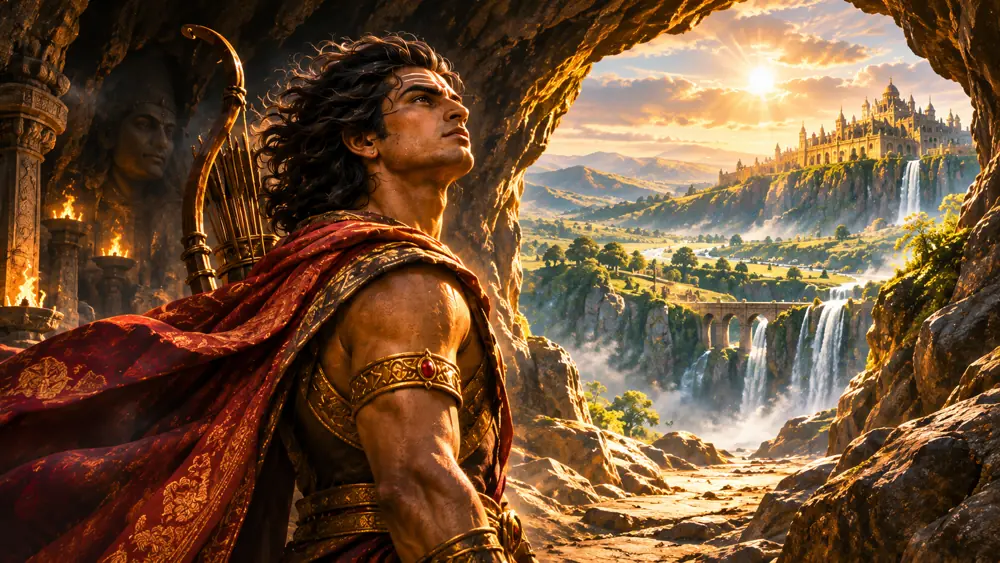
The first thing Vetu learned about the sky was that it refused to stay still. Clouds passed over the upper road, changing the light on the stones. Trees bent and straightened without anyone touching them. He had spent seventeen years beneath the earth, where a lamp burned until someone extinguished it and a wall stayed where a mason had built it. The quartermaster had given him Kaikasi's spare sandals, a packet of salt and an order to accompany the escort as far as the last crossing. Vetu had read the first line and pretended to understand the rest. Now, standing at the mouth of the passage, he wished he had asked the man to read it again.
Beyond the passage, the air tasted of wet bark and cold earth. Vetu stood blinking until Rujan called him to the horses. Kaikasi stood beside the threshold with the travelling cloak folded over one arm. She had refused the litter Sumali sent and the jewellery he considered suitable for an introduction to a sage. She accepted the sandals because their soles could be repaired. Vetu watched her test the straps, then asked whether the trees were always so restless.
“Only when there is wind,” she told him. “You will get used to it.”
“I am not going all the way with you.”
“I know.” She looked at the sealed order in his hand. “That is why you must look while you can.”
Her escort travelled with her through the first wooded mile. They passed a shrine whose steps had been cracked by roots and a woman leading two goats along a path of red soil. The woman stopped when she saw the seal on the escort's satchel. She had once traded salt with the people beneath the earth, and she recognised the mark of the lost house. Her eyes moved to Kaikasi, to the unadorned cloak, and then away. The princess greeted her. The woman answered politely but kept her goats between herself and the strangers.
The captain's name was Rujan. He had served Sumali since before the retreat, and he still wore a ring with the old royal emblem, though the gold had worn thin against his sword hilt. On the second morning he ordered Vetu to walk behind the horses, where he could watch the baggage. Vetu wanted to walk beside the princess, not because he expected her to speak to him, but because she asked questions of people along the road. She had asked a charcoal seller how many days the rains kept his kiln cold. She had asked a girl carrying firewood whether the path beyond the ridge was safe after dark. Rujan called such questions a waste of time. He had brought a map prepared by the palace and trusted it more than anyone who lived upon the road.
At a roadside well they found three travellers arguing with a toll collector. The collector had erected a barrier of bamboo and demanded payment for passage across a bridge maintained by the nearby village. One traveller showed him a token already purchased at the lower crossing. The collector said the token was valid only before noon. Kaikasi asked to see the written rule. There was none. Rujan offered to pay for the party rather than delay them. Kaikasi refused his money, not because she wished to save it, but because the collector had looked at her escort and begun calculating what he might demand from the next unguarded traveller.
“Who appointed you?” she asked. The collector said the village headman had. She asked for his name and where he could be found. The collector lowered the barrier, suddenly eager for them to continue. Kaikasi did not move until the other travellers had crossed. Rujan waited beside her, jaw tight, while a woman with a basket of onions took the opportunity to cross without paying. By the time they reached the far bank the captain was furious. “You cannot challenge every man who lies to you,” he said. “No,” Kaikasi answered. “But I can remember which men become honest when someone asks them to show their authority.”
Vetu remembered the exchange because the toll collector had looked exactly like an official in Rasatal who measured lamp oil. He had always supposed such men belonged to his own underground world. Above it, beneath a sky so wide that it made his stomach uneasy, he found the same small hungers. He also found that Kaikasi had no intention of treating her father's seal as a weapon against strangers. He began to wonder what she intended to do with it when she met the sage.
At a ford the escort found a cart trapped in the mud. Its owner, a widower named Bhadra, had lost one wheel and had been waiting since dawn for someone to help lift the axle. The captain wanted to move on before the afternoon rain. Kaikasi set her bundle down and asked the men to bring the rope from their packs. They obeyed with the displeasure of soldiers whose orders had not included farm work. Vetu held the horse while the axle rose. The wheel slipped once, bruising his wrist. Bhadra apologised to him, though he had been the one waiting in the mud.
When the cart stood upright, Bhadra offered them dried fruit. The captain refused on Kaikasi's behalf. She took a piece and ate it. The widower asked where she was bound. She said she was going to meet a learned man. He said that learned men were common on the road beyond the hills, but those who could mend a wheel were less easily found. Kaikasi laughed. Vetu had heard her laugh in the palace; he had never heard it come so quickly.
The night before the second crossing they slept beneath the eaves of a shrine. Rujan posted a watch. Vetu lay awake listening to insects and to the captain cleaning his blade with a strip of cloth. Beyond the courtyard a family had settled beneath a cart, their youngest child crying because she feared the thunder. Kaikasi carried her own blanket to them and returned without it. When Rujan complained that she would be cold, she said the child was smaller than she was. The captain fetched a second blanket from the baggage and left it at her feet without another word.
Near midnight Vetu heard Rujan speaking to Kaikasi beside the shrine lamp. “Your father will expect a report,” he said. “He will expect to know whether the sage receives you, whether he has wealth, whether he has sons.” Kaikasi replied that her father might ask those things of her when she chose to answer. Rujan said a king could not be expected to wait in ignorance. She asked whether he had followed her to protect her or to carry back the contents of her life. The captain was silent for a long time. Then he said he had been ordered to do both.
“You may report that I was safe when you left me,” Kaikasi said. “You may report that I paid my debts along the road. You may not report words I have not spoken or promises I have not made.” Rujan asked what he should do if Sumali demanded more. Kaikasi looked at the sword across his knees. “You have served him long enough to know that he can be disappointed and still survive it.” Vetu closed his eyes before they noticed he was listening. In the darkness he understood why the captain feared the journey more than he feared an enemy patrol.
The river was higher than Rujan's map allowed for. A ferry rope stretched between two posts, and the boatman had tied his craft beneath a bank of reeds while he waited for the current to ease. Rujan wanted to ford upstream. The boatman said the stones there had been torn loose in the last rain. Rujan offered him a silver coin to cross immediately. The man took the coin, bit it and handed it back. “If the boat turns, silver won't pull your princess from the water,” he said. Kaikasi asked how long the current usually took to fall. He pointed to a wet line on the post and said perhaps an hour. She sat beneath a tree to wait. Rujan paced the bank until Vetu thought he would wear a path through the roots.
A woman with a bundle of dyed thread came to the ferry and recognised the old emblem on Rujan's ring. Her father, she said, had served in Lanka's kitchens and stayed when the royal household fled. Rujan asked his name. She gave it. He remembered a cook who had been accused of stealing pepper and beaten by a palace guard. The woman asked whether the old king still meant to return. Rujan said that was not a question for travellers. She looked at Kaikasi. “If he comes, will he ask who lives in our houses now?” Kaikasi answered that she did not know what her father would ask. The woman nodded as though this was the first reply she trusted.
While they waited, Vetu helped the boatman bail rainwater from the ferry. He asked whether the man had ever been beneath the earth. The boatman said no and did not wish to. Vetu described the pools and the lanterns, then stopped when he heard how small the place sounded. The boatman told him there were people above ground who had never travelled beyond the next hill. “A road is not a promise,” he said. “You may follow it and find you owe more than you carried.” Vetu did not understand until the woman with the dyed thread crossed ahead of them and refused the escort's offer to pay her fare. She had paid for herself, she said, all her life.
When the ferry finally moved, Rujan insisted that Kaikasi stand at the centre. She stood near the boatman instead, watching him feel the pull of the rope through his palms. At midstream the current swung them broadside. Vetu gripped the gunwale and tasted river water. The boatman shifted his weight and shouted for everyone to stay still. Kaikasi obeyed at once. She had argued with guards and toll collectors along the road, but she did not argue with the man who knew how to keep them afloat. On the far bank Rujan said the crossing proved the journey was too dangerous for her to continue alone. She answered that it proved she should listen to people who understood the road.
At the second crossing Kaikasi dismissed the escort. Rujan argued that the roads were unsafe. She asked him to read his instructions aloud. He hesitated, then unfolded the paper. The order authorised him to accompany her as far as the upper road and return with a report of her safety. It did not authorise him to follow her into the hermitage. Vetu watched the captain's thumb settle over the final line, as though he might conceal it from the woman who had negotiated its wording. Kaikasi waited. At last Rujan folded the paper and bowed. His obedience was stiff enough to resemble defiance.
Vetu handed over the spare sandals. For a moment he wanted to ask to accompany her farther. He imagined the river beyond the hills, the hermitage she sought, the sky changing colour every evening. Then he thought of his mother in the lower dwellings and of the wages she depended upon. Kaikasi saw his hesitation and gave him the last of Bhadra's dried fruit. “Tell your mother what the trees look like,” she said.
The escort turned back as the rain began. Vetu kept looking over his shoulder until Kaikasi was no more than a figure moving between the trunks. The captain warned him that a royal journey was not a tale to repeat at the wells. Vetu said nothing. At the last gate he gave the quartermaster the empty sandal bundle and received his pay. That evening he told his mother about the trees, the stuck cart and the goats. He did not tell her which road Kaikasi had taken. His mother asked whether the princess had been frightened. Vetu remembered the ferry swinging broadside and Kaikasi standing still when the boatman shouted. “I was,” he said. He could not answer for her.