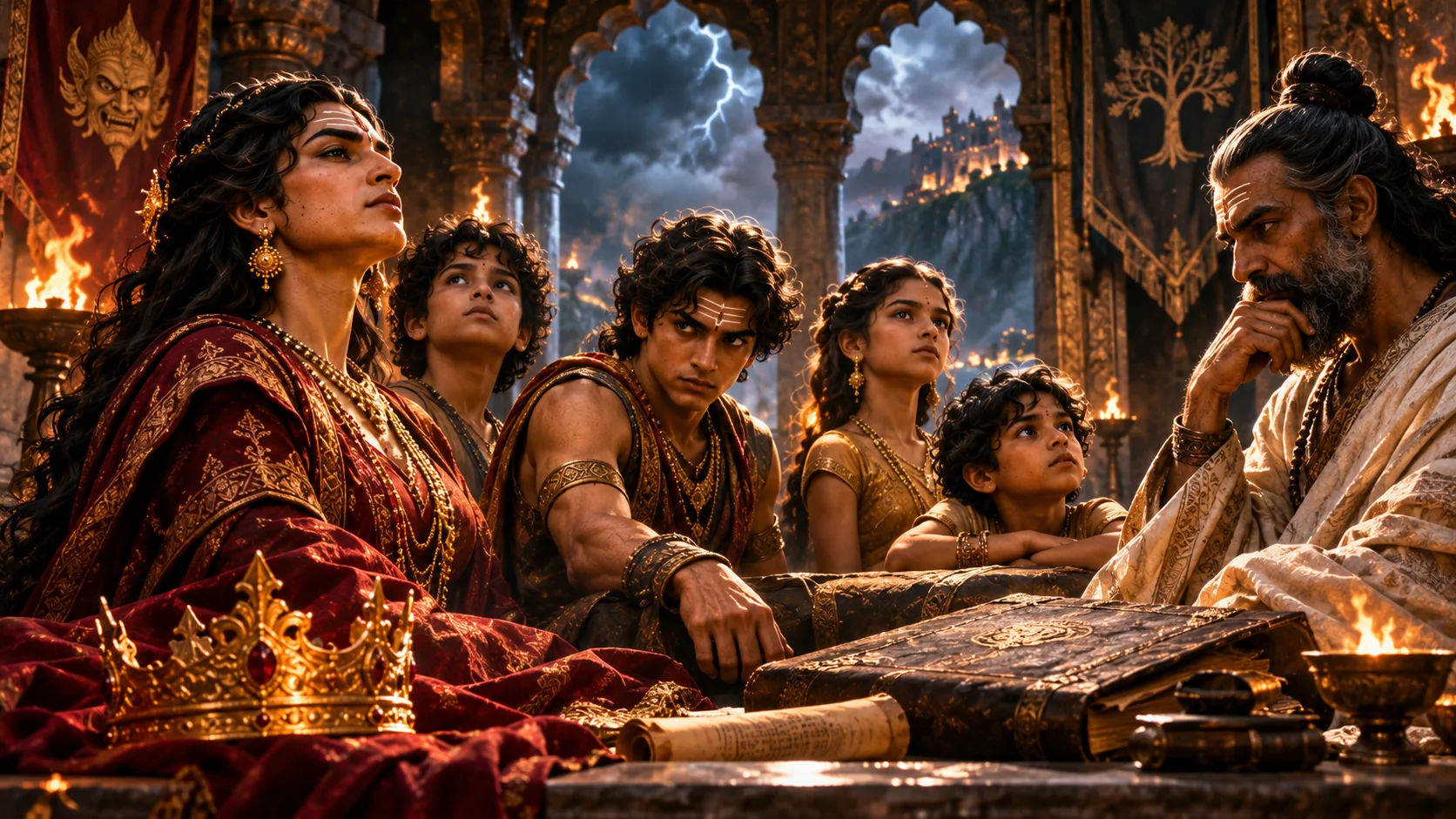
The stranger arrived at the ashram with dust on his sandals and a king's seal hidden beneath his cloak.
He had travelled without a banner. His attendants had been dismissed at the last crossing, where the road narrowed between two hills and the forest swallowed the sound of wheels. The journey had taken him longer than he expected. He had forgotten how large the world above could be, and how little it cared whether a man had once ruled a city of gold.
At the stream he stopped.
The bridge was new. Its stone piers stood against the current, the wooden span raised high enough to clear the monsoon flood. A boy sat on the parapet, peeling a sugarcane stalk with a small knife. He watched the stranger examine the joints.
“Who built it?” the stranger asked.
“Shurpanakha drew it. The village helped.”
“Shurpanakha?”
“She lives at the ashram. My father helped carry the beams.”
The stranger looked at the bridge again. He tested a beam with the toe of his sandal. The workmanship was not elegant, but the weight had been distributed carefully. Sumali had seen a siege engine collapse because one pin had been cut from green timber. He could not tell whether the bridge would stand through another monsoon.
“And the well?” he asked, noticing a fresh path cut toward the settlement.
“The tall one lifted the fallen stones. The carpenter and the others built it back. You know the one everyone talks about?”
The stranger did not ask for a name. He already knew it.
He took a copper coin from his purse and offered it to the boy. The boy looked at the coin, then at the stranger.
“Why?”
“For answering my questions.”
“They were easy questions.”
“Not everyone answers easy questions honestly.”
The boy considered this. Then he took the coin, tucked it into his waistband and returned to his sugarcane.
Sumali crossed the bridge.
He had imagined this meeting for so many years that he had worn grooves into it, like a man walking the same narrow path through stone. In one version, his daughter wept and embraced him. In another, she demanded to know why he had stayed away. In every version his grandsons understood at once who he was and what they owed him.
He had not imagined a bridge built by his granddaughter.
Nor had he imagined being hungry.
The smell of lentils came from the cooking shed. Somewhere a woman was singing while she washed clothes. A pair of students argued over the correct pronunciation of a verse. The ashram was neither poor nor rich. Its roofs needed mending; its courtyard had been swept; the grain jars stood beneath a shaded veranda with their lids weighted against rats.
There was nothing here that resembled Lanka.
He looked again at the grain jars, the patched roof and the bridge. His daughter had built a life here without a court, and not one of the people crossing the courtyard had stopped to ask his permission.
Kaikasi saw him from the garden.
She had been cutting dead leaves from a medicinal plant. Her hands were stained green. For a moment she did not move, and he saw in her face the young woman who had stood beneath the blue lamps and refused to promise him sons.
Then she set down the knife.
“Father.”
He had rehearsed a hundred greetings. None survived the sound of her voice.
“You have grown thin,” he said.
“So have you.”
“That is what the years do.”
“Not to everyone.”
She crossed the garden and embraced him. He felt how strong her arms had become. The embrace lasted long enough for him to believe, foolishly, that the years between them had closed.
Then she stepped away.
“Why have you come?”
“I wished to see you.”
“Only me?”
He looked past her toward the house.
Kaikasi sighed. “You might at least have waited until after the meal to lie.”
She led him beneath the veranda and gave him water. He drank slowly, aware that she was watching the seal on his cloak.
“You still carry it,” she said.
“It belonged to your grandfather.”
“It belonged to a government that no longer exists.”
“A kingdom does not cease to exist because its king has been driven out.”
“Tell that to the people who remained.”
He set down the cup. He had not travelled so far to quarrel about the dead. But he could not speak of Lanka without finding them between himself and every living person he loved.
“Is Vishrava here?”
“In the library. He knows you are coming.”
“You sent word?”
“No. A traveller reported an old man asking questions about our family. You have never been good at disguising your interests.”
A voice sounded from the courtyard.
“Mother?”
Dashagriva approached carrying a length of timber across one shoulder. He had been helping repair the roof of the grain store. Sweat darkened his tunic, and sawdust clung to his arms. He set the timber down when he saw the stranger.
Sumali rose.
There he was: the grandson he had sought in dreams, the descendant born of two houses, the boy whose name had crossed markets and courts and even the deep places beneath the earth. He was not dressed as a prince. He wore no ornaments. Yet there was something in the way he stood that made the old king's breath catch.
“Dashagriva,” Sumali said.
The young man looked at Kaikasi.
“This is your grandfather,” she told him.
Dashagriva bowed. It was a measured bow, respectful without surrender.
“I have heard much about you.”
“And I about you.”
“Mother says you ruled Lanka.”
“I did.”
“Mother says you lost it.”
Sumali studied him. There was no mockery in the words, which made them harder to bear.
“Yes,” he said. “I lost it.”
Dashagriva lifted the timber again. “Then you know what it costs to build something twice.”
Sumali glanced toward the repaired roof. “I know what it costs to have something taken.”
“That is not the same thing,” Kaikasi said.
Dashagriva smiled faintly. He had heard his mother and grandfather disagree in stories all his life. The real argument, it seemed, had begun before anyone had finished drinking water.
“Will you stay?” he asked.
“For a little while.”
“Then you should eat. Kumbhakarn has been awake since dawn and the cook is afraid there will be nothing left.”
Sumali watched him carry the timber away.
“He is powerful,” he said.
“He is useful,” Kaikasi replied. “There is a difference.”
“You have taught him to repair roofs.”
“I have taught him to notice when they leak.”
She went to call the others.
At the meal Sumali met his grandchildren as a family rather than as the names he had carried like weapons.
Kumbhakarn filled his plate, offered the old man the largest piece of bread and fell into a discussion about the best way to keep grain dry during the rains. Vibhishan asked about Rasatal's schools and listened closely when Sumali described the teachers who had survived the exile. Shurpanakha wanted to know whether the underground mines still used the old pulley system. When Sumali said they did, she began explaining how a different arrangement of weights could reduce the strain on the workers.
“You would need iron,” he said.
“We have iron.”
“You would need men who know how to cast it.”
“Then teach them.”
He stared at her. She did not appear to understand why the answer surprised him.
Vishrava joined them after the first course. He greeted Sumali courteously, neither deferential nor hostile. The sage had aged. His beard was silver now, his hands marked by ink and the fine cuts left by palm leaves. But his eyes were clear.
“You have come a long way,” Vishrava said.
“I have come to see my family.”
“Then you are welcome as family.”
The words were generous. Sumali found that generosity more difficult to answer than suspicion.
He had intended to speak of Lanka at once. Instead he ate the rice placed before him and listened while Shurpanakha and Kumbhakarn argued about whether a pulley could lift a loaded cart without breaking its axle.
Dashagriva laughed when his sister called Kumbhakarn an ox with opinions. Sumali watched the laughter change his face. It was a young face, after all, though the old king had spent years imagining a conqueror.
In Rasatal the children of exile learned to recite the names of the dead before they learned the names of flowers. Here, his grandchildren argued about timber, music and dinner. Sumali could not decide whether Kaikasi had betrayed their inheritance or saved them from it.
That night he asked to walk with Dashagriva.
They followed the stream beyond the last lamps. Fireflies moved among the reeds. The repaired bridge stood upstream, a dark shape against the water.
“I have heard of your austerities,” Sumali said.
“People hear many things.”
“I heard Brahma answered you.”
“He did.”
“And granted protection?”
“From those I named.”
Sumali waited. Dashagriva did not continue.
“You were wise to ask,” the old man said at last. “Your great-uncle Mali believed strength alone would preserve him. Vishnu taught him otherwise.”
“Mother told me.”
“Did she tell you how he died?”
“She told me he went to war because he believed no one could defeat him.”
Sumali stopped walking. It was not the story he had taught his daughter.
“Mali went because the Devas threatened our house.”
“Perhaps both are true.”
The answer came too easily. Sumali heard Kaikasi in it, and Vishrava, and perhaps the irritating precision of Vibhishan. He wondered whether any of his own words had survived in the young man.
“Your mother has told you of Lanka.”
“Every stone,” Dashagriva said.
“Then you know it was ours.”
“I know you ruled it.”
“It was built by our people.”
“And other people live there now.”
Sumali turned toward him. “Would you have them keep what was taken?”
“I would know what I was taking from them.”
For a moment the old king felt the strange urge to strike his grandson. Not because the boy was wrong, but because he sounded as though he could afford to be right.
“You speak like a man who has never been dispossessed.”
Dashagriva looked toward the stream. “I have spent my life being told that something belongs to me and being shown that it belongs to someone else. Is that not a kind of dispossession?”
“It is the beginning of one.”
“No,” Dashagriva said. “It is the beginning of an argument.”
Sumali stared at him. Then, against his will, he laughed.
“You have your mother's tongue.”
“And my father's patience, when I remember to use it.”
“You will need more than patience.”
“I know.”
The old man drew a folded cloth from inside his cloak. It was the map he had carried for years, the one marked with the harbours and terraces of Lanka. The edges had been repaired with thread. A new black mark stood beside the western gate.
Dashagriva accepted it carefully.
“Who drew this?”
“I did. After the retreat. From memory.”
“What is the mark?”
Sumali looked at the western gate. He had made the mark after reading Tarini's ledger. He had never told anyone why.
“People waited there for ships,” he said.
“Soldiers?”
“Families.”
“How many?”
“I do not know.”
Dashagriva looked up. “You kept a map but not a count?”
The old king's fingers tightened around the edge of his cloak.
“I kept what I could.”
Dashagriva studied the mark for a long time. Then he folded the map and held it out.
“Keep it,” he said. “You remember the city as it was. I would rather see it as it is.”
Sumali did not take the cloth.
“Kuber has offered you a visit.”
“He has.”
“Have you accepted?”
“No.”
“Why?”
“Because I do not yet know whether I could enter as his guest without resenting him.”
It was the first unguarded thing Dashagriva had said all evening.
Sumali understood it completely.
“You could enter as something else.”
Dashagriva's gaze sharpened. “What?”
“A claimant.”
The word seemed to change the air between them. A frog called from the far bank. Somewhere in the forest a branch cracked under an animal's weight.
“A claimant must have a claim,” Dashagriva said.
“You have blood.”
“Kuber has blood.”
“You have the house that built the city.”
“He has the people who live in it.”
Sumali stepped closer. “Do you think the people of Lanka love him? Do you think they have forgotten us?”
“I do not know. Neither do you.”
“I have friends there.”
“Then ask them what they want.”
“Kings do not ask permission to be kings.”
Dashagriva looked down at the map. He remembered the village well, the cracked lining, the way the villagers had watched him lift the stones. He remembered wanting their admiration more than their advice. He had been ashamed of that desire, though not enough to forget its sweetness.
“If I ever rule Lanka,” he said, “I will not begin by breaking it.”
Sumali's face softened. “Then we agree.”
“No,” Dashagriva said. “We have only discovered that we want the same city.”
He returned the map.
Sumali took it. He was no longer certain whether he had found an heir or an adversary.
When they came back, the ashram was quiet. Kaikasi waited beside the lamp, a book open in her lap. She did not ask what they had discussed. Her father had never told her the truth about a conversation until he had decided what use he could make of it.
Dashagriva went inside.
Sumali remained beneath the veranda. For the first time that day he looked tired enough to be old.
“You have raised him well,” he said.
“I have raised him,” Kaikasi answered. “What he becomes is not entirely mine to decide.”
“He could take Lanka.”
“Yes.”
“You know it.”
“Yes.”
“And you would stop him?”
She closed the book.
“If he means to kill his brother for a throne, I will stand in his way.”
Sumali's expression hardened. “You would choose Kuber over your own blood?”
“Kuber is also Vishrava's son. And the people in that city are not pieces on your board.”
“My brother Mali died defending that city.”
“So did Tarini's husband. She was never given a body to bury.”
He flinched at the name. The woman with the ledger had become old. Her hands trembled now when she wrote, but she still wrote. He had visited her before leaving Rasatal and found her teaching Ila how to repair the bindings of the third ledger. There had been more pages than he remembered.
“Tarini sent something,” he said.
From his cloak he took a small packet wrapped in plain cloth. Kaikasi opened it. Inside lay a copied page bearing seven names, the same seven she had carried from Rasatal years before. Beneath them Ila had written the names of children born to the families that survived.
Kaikasi read the additions one by one.
The carpenter's daughter had become a mason. The woman who taught her daughters to swim had a granddaughter who repaired fishing nets. The dead had not returned. The living had continued.
“Why did she send this?” Kaikasi asked.
“She said you would know.”
Sumali watched his daughter fold the paper. He had brought maps, claims and the promise of a kingdom. Tarini had sent a page no larger than his hand, and it had reached Kaikasi more surely than anything he had said.
At dawn the old king prepared to leave.
Dashagriva came to the bridge to see him off. The boy with the sugarcane was there again, this time with two friends and a wooden toy cart. Its axle had broken. Shurpanakha had promised to mend it after breakfast.
“Will you come to Rasatal?” Sumali asked.
“One day.”
“There are people who would follow you.”
“People who have met me?”
“People who have waited for you.”
Dashagriva looked at the children beside the bridge. They were arguing over whose turn it was to push the broken cart. None of them knew what a boon from Brahma meant. None of them cared who had once sat upon the throne of Lanka.
“Waiting is not the same as knowing,” he said.
Sumali mounted his horse.
He had come expecting to place an inheritance in his grandson's hands. Instead he left with questions, a map, and the knowledge that the young man could refuse him.
It was not defeat. Sumali had survived worse than refusal.
At the bend in the road he looked back.
Dashagriva had knelt beside the children's cart. He was holding the broken axle while one of the boys explained, with great seriousness, how it had failed. The young man listened.
Sumali watched until the trees hid them.
Then he turned his horse toward the south, where the road would eventually lead to men who remembered the old banners, captains who disliked Kuber's taxes, merchants who owed debts to the house of Sumali, and others who could be persuaded that the future ought to resemble the past.
Before he reached the main road, Sumali stopped at a roadside shelter where the boy's mother was dividing a pot of millet among three children. She recognised his ring before she recognised his face and rose so abruptly that the ladle struck the rim.
“Sit,” he said. “I have eaten.”
It was not true. He had left the ashram before breakfast, unwilling to endure another meal at which Dashagriva would speak of repairing wells instead of taking cities. The youngest child watched him from behind her mother's shoulder. A patch of old burn scar ran along the woman's wrist.
“The bridge was repaired by your granddaughter,” she said. “The cart road is still broken farther down. A trader lost a wheel there yesterday.”
Sumali looked at the ruts. He had studied the roads to Lanka for years; he had not noticed this one until a woman told him what it cost to use it.
“There are men at the hermitage who can mend it,” he said.
“They are mending the village well.”
He reached for the purse at his belt, then stopped. Coins might buy timber. They would not bring a carpenter away from a well already half repaired. He had ordered men away from unfinished work before, when a wall or a gate seemed more urgent than a household's roof. He asked what the village had decided to do, and heard how strange the question sounded in his own mouth.
“Wait until the rains end. We have no one to spare.”
Sumali had come looking for a grandson who might command an army. He found himself asking whether the village could spare two people for a day if someone supplied the wood and paid their wages. The woman said she would ask the others. She did not thank him; he had not yet supplied anything.
At the next turn he sent a rider back with money for timber and a note asking the village to choose its own workers. Then he took out the list of captains who had offered him soldiers. He crossed off one name and wrote beside another: Ask who pays them. The rider would have to wait for an answer. Sumali had bought neither gratitude nor a repaired road, and he still intended to return to Lanka.
He had promised Kaikasi that he came to see his family.
That had been true.
It had not been the whole truth.